

AI Summary of Peer-Reviewed Research
This page presents an AI-generated summary of a published research paper. The original authors did not write or review this article. See full disclosure ↓
Publication Signals show what we were able to verify about where this research was published.MODERATECore publication signals for this source were verified. Publication Signals reflect the source’s verifiable credentials, not the quality of the research.
- ✔ Peer-reviewed source
- ✔ No retraction or integrity flags
Key findings from this study
This research indicates that:
- Columnar vortex generators shortened recirculation zones and reattachment lengths on the ONR Tumblehome superstructure.
- Turbulence intensity and velocity fluctuations over the flight deck decreased with appropriately positioned CVG integration.
- Passive airwake control through CVG modifications improved flow conditions without requiring active systems.
Overview
Researchers validated ship airwake characteristics on the ONR Tumblehome model in model scale. Columnar vortex generators (CVG) were designed and implemented as passive airwake controllers on the superstructure. CVG integration produced measurable improvements in airwake flow quality over the flight deck.
Methods and approach
Unsteady RANS equations were solved using hexahedral finite volume discretization. An atmospheric boundary layer (ABL) was modeled to establish realistic inlet velocity profiles. Columnar vortex generators were designed and integrated into the superstructure geometry following initial validation of baseline airwake conditions.
Results
CVG implementation significantly improved airwake characteristics compared to the baseline configuration. The vortex generators shortened the recirculation region and reduced reattachment length when positioned appropriately on the superstructure. These geometric modifications generated lower turbulence intensity and reduced velocity fluctuations across the flight deck region.
The computational analysis demonstrated that specific CVG geometries produced the most effective airwake healing. The passive control strategy maintained the improvement without requiring active systems or additional operational complexity.
Implications
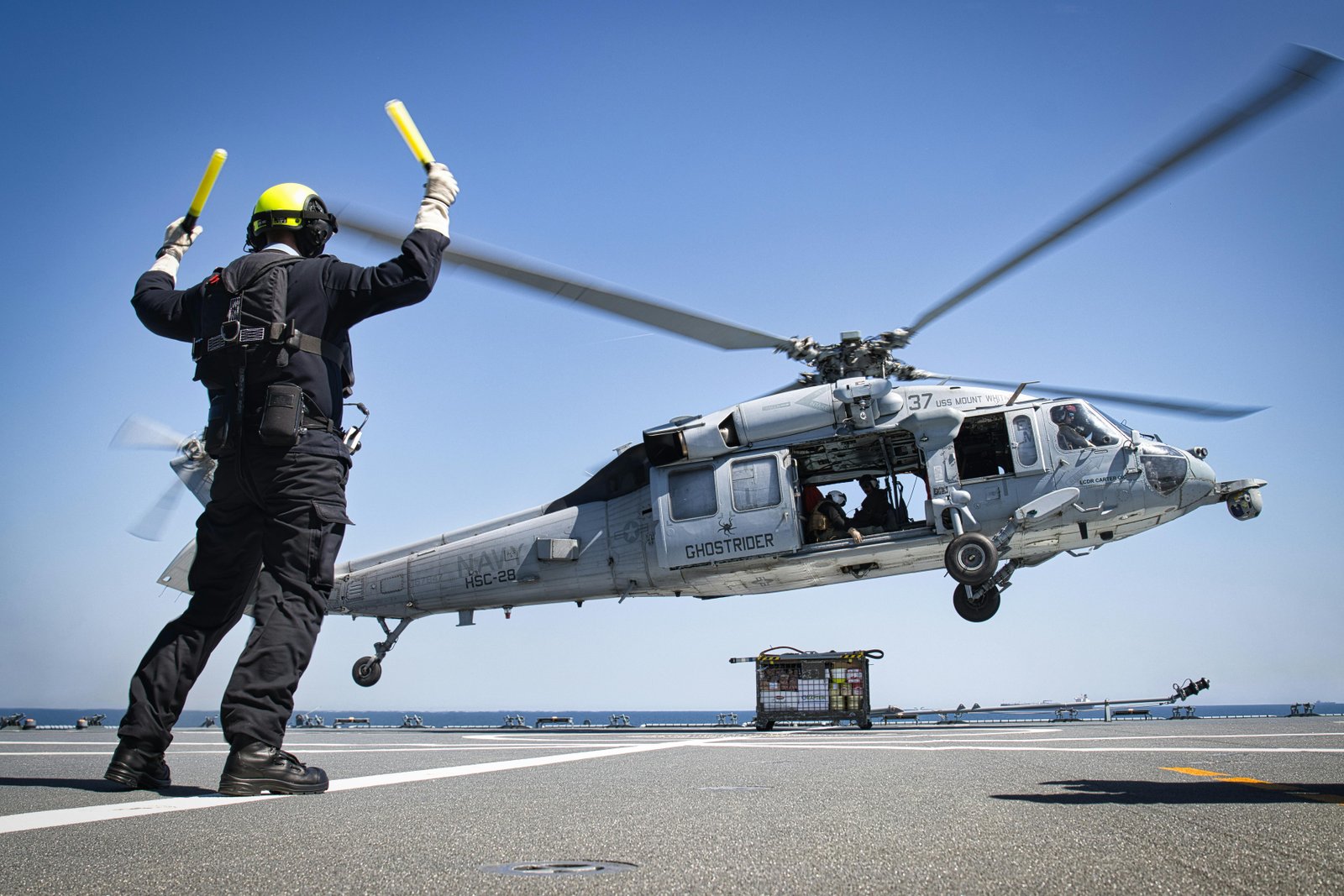
Passive airwake control through CVG integration offers a practical approach to enhance flight deck operations on ships with superstructure-induced recirculation. Reduced turbulence intensity and flow unsteadiness directly improve helicopter operating conditions during landing and takeoff operations. The methodology establishes a framework for systematic aerodynamic optimization of ship superstructures supporting aviation operations.
These findings may inform naval vessel design practices by demonstrating that superstructure geometry modifications can mitigate adverse airwake effects. Application of columnar vortex generators represents a low-cost retrofit potential for existing vessels or incorporation into new designs. The computational validation approach supports integration of aerodynamic performance into early-stage ship design processes.
Scope and limitations
This summary is based on the study abstract and available metadata. It does not include a full analysis of the complete paper, supplementary materials, or underlying datasets unless explicitly stated. Findings should be interpreted in the context of the original publication.
Disclosure
- Research title: AIRWAKE CONTROL OF ONR TUMBLEHOME USING CVG
- Authors: Bekir Kürşat Kıyak, Sarih Sarı, Ali Doğrul, Seyfettin Bayraktar
- Institutions: Yıldız Technical University
- Publication date: 2026-04-08
- DOI: https://doi.org/10.56850/jnse.1846478
- OpenAlex record: View
- Image credit: Photo by Germannavyphotograph on Pexels (Source • License)
- Disclosure: This post was generated by Claude (Anthropic). The original authors did not write or review this post.
Get the weekly research newsletter
Stay current with peer-reviewed research without reading academic papers — one filtered digest, every Friday.