

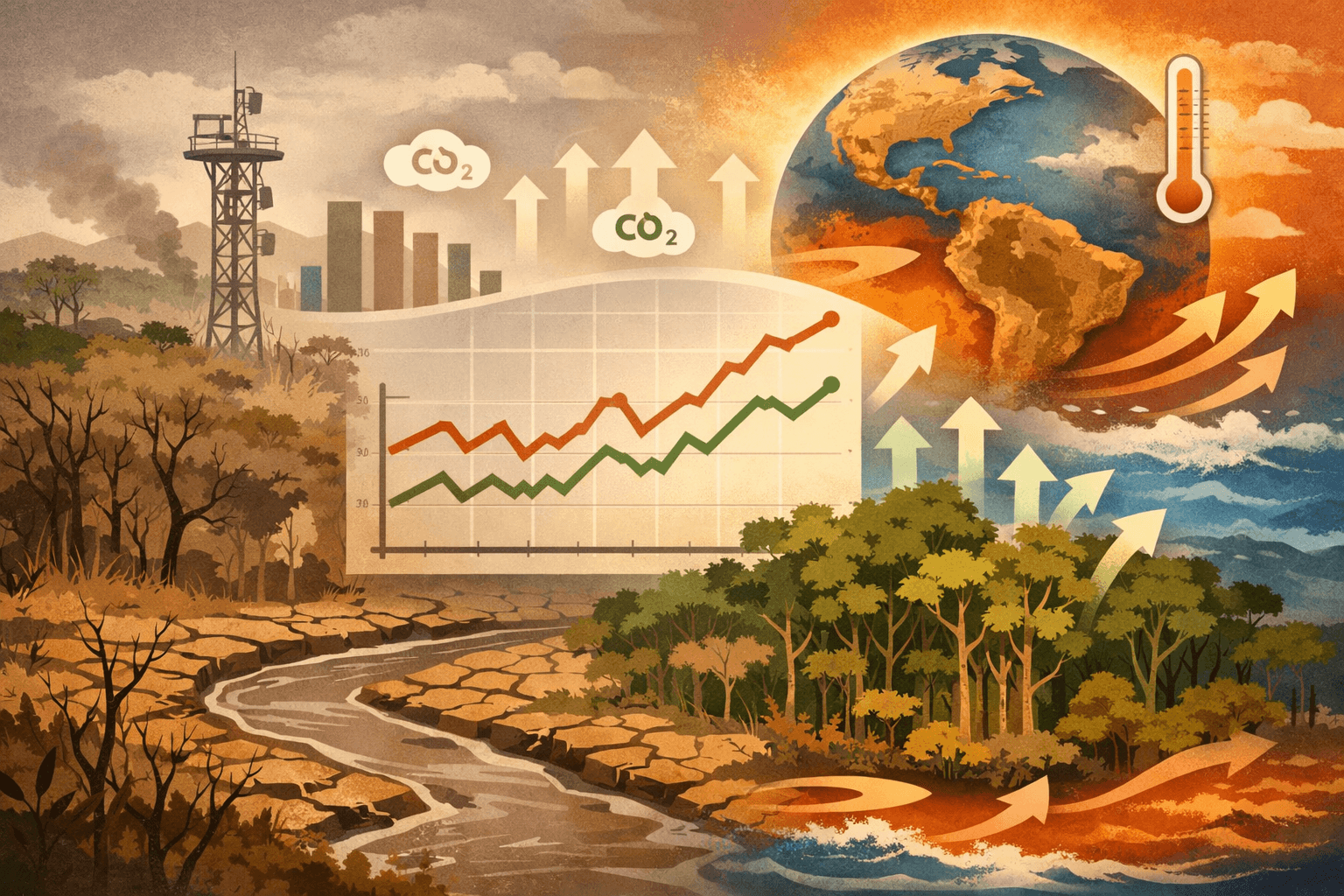
What the study found: The 2023 extreme drought reduced vegetation carbon uptake across the Amazon, and the region became a weak net carbon source. The study also reports that early-year vegetation uptake was stronger than normal, which helped offset some later carbon losses.
Why the authors say this matters: The authors conclude that reduced vegetation carbon uptake contributed to the Amazon's net carbon loss in 2023. They also state that the Amazon's weak carbon source contributed up to 30% of the net carbon loss in tropical land that year.
What the researchers tested: The researchers evaluated the Amazon carbon cycle during the 2023 event at different spatial scales. They combined atmospheric carbon dioxide mole fractions, eddy covariance flux data, low-latency Dynamic Global Vegetation Model simulations, an atmospheric inversion, and remote sensing data.
What worked and what didn't: The Amazon region was estimated to be a net carbon source of 0.01–0.17 PgC in 2023, including fires. Fire emissions were 0.15 [0.13–0.17] PgC and were within the typical variability of 2003–2023, so the authors attribute the weak source mainly to reduced vegetation uptake during the dry season (August–October). They also report a shift from carbon sink to source in May and a peak source in October.
What to keep in mind: The abstract does not describe detailed limitations. The findings are specific to the 2023 drought event and the data sources and spatial scales used in this study.
Key points
- In 2023, the Amazon was estimated to be a weak net carbon source rather than a carbon sink.
- The authors attribute the weak source mainly to reduced vegetation uptake during the dry season.
- Fire emissions were within typical variability for 2003–2023 and were not identified as the main cause.
- Early-year vegetation uptake was stronger than normal and partially offset later losses.
- The authors state the Amazon's weak carbon source contributed up to 30% of tropical land net carbon loss in 2023.
Disclosure
- Research title:
- Extreme 2023 drought turned the Amazon into a weak carbon source
- Publication date:
- 2026-02-01
- OpenAlex record:
- View
Get the weekly research newsletter
Stay current with peer-reviewed research without reading academic papers — one filtered digest, every Friday.